Automotive Engineering Speeded by Geometric Deep Learning

AI is accelerating R&D capabilities across industries, with a recent McKinsey report estimating use of the technology could generate up to $560 billion for companies across sectors such as pharmaceuticals, chemicals and aerospace.
One company already seeing significant R&D progress through the use of AI is Altair, a Michigan-based software company using geometric deep learning to accelerate engineering innovations in the automotive industry.
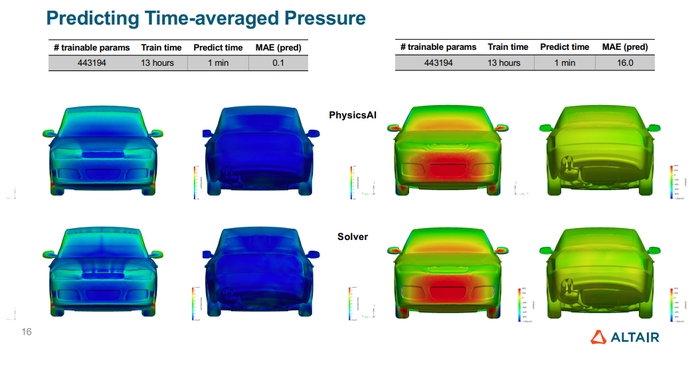
This system called PhysicsAI essentially acts as an AI foundation model trained on 3D structural data rather than natural language. This allows it to understand and design intricate physical objects, such as satellites or vehicle components.
Fatma Kocer-Poyraz, vice president of engineering data science at Altair, is spearheading the technology’s application in physical product design, which is typically limited by expensive prototyping and time-intensive simulations.
“We engineer almost everything we touch,” Kocer-Poyraz told AI Business. “When you think of a car, it’s not just the exterior, it’s everything from the subframe to how thick a part is, how it curves, what it’s made of and how it’s manufactured. Every single decision counts.”
While traditional engineering workflows often rely on costly physical prototypes that can take hours, days or even weeks to complete, PhysicsAI enables rapid test simulations that allow products to progress through several iterations before transitioning to the real world.
“In engineering we typically have a one-off prototype that’s tested physically,” Kocer-Poyraz said. “But this is incredibly expensive, because if you crash a vehicle then that’s it, you can’t reuse it. So our work is really moving from physical to virtual tests.”
Credit: Altair
Altair’s system allows companies to train AI models on historical simulation data, which Kocer-Poyraz said has proven difficult in the past for engineering applications.
“Using historical data in something like engineering is actually typically very difficult, because we work with 3D geometries, which are really hard to represent in a way that machine learning algorithms understand,” she added. “So our goal with this was to train a machine learning algorithm in the language of engineering. We realized geometric deep learning was the answer. It allowed us to build an AI that understands both 3D shape and performance data.”
Altair’s system has already been deployed across industries including electronics, aerospace and heavy industry, though predominant interest has been in automotive. For example, Magna, a Fortune 500 auto parts manufacturer, is already using PhysicsAI to optimize components.
Altair is preparing to launch a diffusion model-based extension that not only predicts performance but also generates new design concepts outright, which Kocer-Poyraz said would be a complete game changer for industries.
“Predicting the performance of a design is amazing, but we’re now looking at how this will actually help to optimize the design process,” she said. “Imagine saying, ‘Give me 500 design concepts,’ and the AI delivers. Then you just pick the 20 best ones to refine further,” she said. “That’s going to change everything.”
Kocer-Poyraz offers one piece of advice for those eager to harness the technology: be data-disciplined.
“To leverage these technologies, your organization must have a culture of capturing, storing and organizing simulation data,” she emphasized.
link