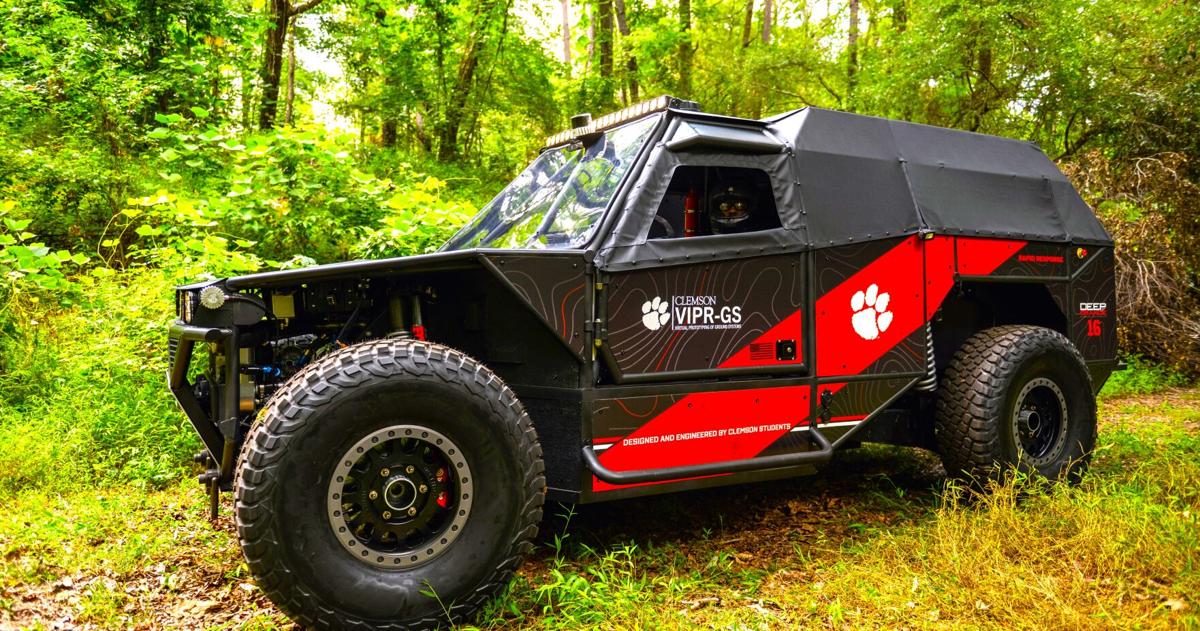
Clemson unveils Deep Orange 16

Clemson University has unveiled Deep Orange 16, a next-generation, semi-autonomous vehicle designed to transform emergency response in extreme conditions. Developed by graduate automotive engineering students in the University’s acclaimed Deep Orange program, the vehicle merges advanced technology with mission-critical functionality to enhance the speed, safety and efficiency of rescue operations.
Sponsored by the Virtual Prototyping of Autonomy-Enabled Ground Systems (VIPR-GS) Research Center and developed in collaboration with the U.S. Army and other strategic partners, Deep Orange 16 is engineered to tackle some of the toughest challenges in high-risk rescue scenarios — reducing response time while limiting the number of personnel needed in the field.
Mission-Driven Design:
Inspired by the real-world challenges faced during Hurricane Helene, the Deep Orange 16 team engineered the vehicle to support critical disaster response efforts. On its outbound journey, the vehicle can deliver a full pallet of emergency supplies to affected areas. For the return trip, the vehicle operates autonomously — transporting up to six individuals, including injured passengers, to safety. Capable of reaching the scene within the “golden hour,” the vehicle also generates a high-resolution digital terrain map for the autonomous return, allowing the original driver to remain on-site and assist ongoing rescue efforts.
Engineered for the Elements
• High-speed, semi-autonomous vehicle with a 350-kilometer range and off-road capabilities built for unpredictable terrain.
• Series hybrid powertrain enables continuous battery charging to extend range and supports near-silent operation for special mission scenarios.
• Designed for real-time deployment, Deep Orange 16 features a lightweight, weatherproof exterior engineered for reliable operation in a variety of environmental conditions.
Innovative Monitoring
• A 360-degree camera system provides full situational awareness, including tire-level views for obstacle detection.
• An AI-powered heads-up display alerts drivers to hazards up to 100 feet away, enhancing navigation and safety.
• Onboard medical monitoring tracks patient vitals in real time, including temperature, heart rate and perspiration during transport.
Rescue-Ready Interior
• Interior accommodates the transport of six people, including a rotating passenger seat to support multiple operational roles.
• Ergonomic litter loader streamlines patient or supply loading.
• MOLLE storage system offers secure, modular organization of rescue and medical gear.
• Rear hatch fits a standard pallet of supplies, while the clam-shell design enables flexible loading of oversized cargo.
• Integrated exterior compartments securely transport fire rescue equipment.
Deep Orange 16 showcases the innovation, technical expertise and dedication of the 17-member team of graduate students from Clemson’s automotive engineering program. “Deep Orange pushes us to think like real-world engineers,” said team lead Rohit Godse. “We are not just learning theory, but solving complex, high-stakes problems that prepare us to lead in the industry from day one.”
From initial concept to fully functional prototype, the team collaborated with the VIPR-GS Research Center, government agencies, and industry partners to solve practical challenges — gaining hands-on experience that prepares them to enter the workforce as industry-ready engineers. “The Deep Orange program demonstrates what’s possible when academia, government and industry come together to solve real-world problems,” said Robert Prucka, Ph.D., Kulwicki Endowed Professor and Chair of the Department of Automotive Engineering. “Our students are not only driving innovation — they’re helping to save lives by improving how we respond to emergencies in the most challenging environments.”
Deep Orange 16 was officially unveiled at the Ground Vehicle Systems Engineering & Technology Symposium (GVSETS) in Novi, Michigan. It will now serve as a test and validation platform for ongoing research by the VIPR-GS Research Center, located at the Clemson University International Center for Automotive Research (CU-ICAR) in Greenville, South Carolina.
link