
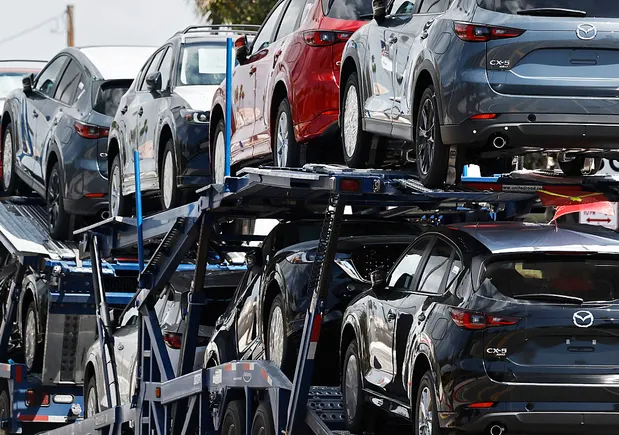
Tariffs swing volumes up and down for auto haulers

This audio is auto-generated. Please let us know if you have feedback.
Editor’s Note: This story is the third installment of a five-part series highlighting intermodal growth in the Chicago area and its impact on trucking.
From the shutdown of auto carrier Jack Cooper to tariff-driven swings in freight volumes, trucking companies and brokers that haul for the automotive sector have weathered a tumultuous year to date.
Michael Stevens, COO of Reindeer Logistics, an Indiana-based freight broker focused on auto transport, doesn’t anticipate stability in the near future. Big questions remain over what happens next with tariffs, how automakers might adjust imports or supply chains, and how fleets that work with auto shippers should respond.
“There is uncertainty about what the market will do over the next few years and if carriers should continue to grow their fleet,” Stevens said.
This year, tariffs on vehicles and parts have driven automakers to adjust imports and supply chains to avoid costly duties. The knock-on effect has reverberated through the trucking sector, with altered volumes on freight lanes, creating volatility for motor carriers and freight brokers that provide services for the automotive sector.
In late March, the White House issued an executive order implementing 25% tariffs on vehicles — such as sedans, SUVs, crossovers and minivans, along with engines, transmissions, powertrain parts and electrical components — manufactured outside of the U.S. The administration later revised tariffs, which took effect in early May, that allowed automakers that assembled their vehicles in the U.S. to seek up to 3.75% relief of their tariff costs related to auto imports for one year.
Ahead of the deadline, automakers and suppliers rushed to import cars and components before duties took effect. OEMs, many of which operate just-in-time supply chains, ordered buffer stock to fill up warehouses, according to Vanessa Miller, litigation partner with Foley & Lardner LLP and chair of the firm’s national Automotive Team in Detroit.
“That drove more trucking and transportation requirements,” as automakers work to stockpile products ahead of tariffs, Miller said.
Stevens said Reindeer’s larger carrier partners saw a similar spike, with “an initial surge in volume to get vehicles to dealers and clients before tariffs fully went into effect.” For the rest of the year, volumes have normalized, but “tariffs remain a conversation and concern for 2026 vehicle orders and overall fleet strategies,” he added.
Trucking takes hit from tariffs
Mick McGrory, COO of Sunset Transportation, a freight broker based in St. Louis, Missouri, said tariffs on automobiles and auto parts are “already creating negative effects,” for trucking. Freight demand is changing “in uneven and regionally specific ways,” McGrory said.
This is evident in cross-border freight. Along the U.S.-Canada border auto hauls spiked to $5.9 billion in March, before the tariffs hit, according to the Bureau of Transportation Statistics. They dipped dramatically in the months that followed, hovering at or below $4 billion.
A similar pattern transpired in Mexico — the biggest origin country for autos coming into the U.S. Auto hauls across the U.S.-Mexico border reached near record levels of $7.7 billion in March. But by July with tariffs in effect, vehicle freight dropped to $6.1 billion.
Then September marked a record-setting month for Mexico’s exports to the U.S., but automotive was not among the contributors, according to C.H. Robinson Worldwide. As exports grew 13.8% year over year, the highest in 14 months, automotive exports to the U.S. fell 7.2%.
Cross-border auto hauls dip after frontloading spike
Freight flow, in dollars, of all vehicles (other than railway vehicles) moved cross-border by truck.
Tariffs on auto parts and materials have also had an impact on the southern border, with C.H. Robinson noting lower demand for southbound trucks. “Fewer parts are heading into Mexico for assembly, complicating trailer repositioning for re-export,” the brokerage wrote in a September market update.
McGrory said automotive parts frequently cross U.S. borders with Canada and Mexico, sometimes multiple times per day. While the U.S.-Mexico-Canada Agreement exempts tariffs on certain compliant parts, “the scope of these tariffs is complex,” he added.
Miller said when the Trump administration announced automotive tariffs this year, manufacturers worked to reduce repeated border crossings, cutting trucking demand. Some auto manufacturers even turned to air freight to quickly bring in shipments because “to fly it over was cheaper than to pay the tariffs” when they took effect, she said, noting that would have altered patterns for trucking carriers hauling out of seaports and airports.
“There was a real push to get product here before certain tariffs went into effect,” Miller said.
Carriers focus on cost control
Many auto manufacturers expect tariffs will be in place through the current administration and possibly beyond, Miller said. That’s driving manufacturers to rethink what they’ll produce and where.
Until there’s more clarity, trucking carriers with automotive shipper customers continue to contend with uncertain volumes and difficulties in long-term planning. Instead, they’re zeroed in on the here and now and seeking operational efficiencies to maintain profits, according to Matt Bradley, CEO of Super Dispatch, a Kansas City, Missouri-based firm that develops software platforms for auto transport carriers that primarily haul used vehicles.
“Our everyday conversations with carriers don’t focus on tariffs,” Bradley said. “For most carriers, the focus is on what’s right in front of them and what they can control.”
Bradley said more carriers are embracing technology for tasks such as status calls, paperwork, digital reports and automated invoices to be more productive in a volatile freight market.
“A few years ago, a lot of folks didn’t want anything to do with tech. Now they’re realizing it’s the only way to keep up,” Bradley said.
Stevens of Reindeer Logistics advised trucking carriers to stay informed on tariffs and build a few scenario planning models to adapt to cost and volume fluctuations.
Sunset Transportation’s McGrory said the full impact of automotive tariffs on the trucking sector is “still unfolding.” Exemptions, revisions and pending challenges in court are all contributing to an “unsettled” freight market, he added.
“The industry currently sits in a transition phase rather than a period of stability,” McGrory said.
link

